

Want to hit heavy, dipping topspin like the pros, but don’t have a hitting partner, an expensive ball machine, or a coach constantly standing over your shoulder?
You are not alone. For most recreational players, finding consistent hitting partners is one of the biggest bottlenecks to improving their game. But here is the secret: you do not need a partner to master topspin. In fact, practicing alone is often the most efficient way to isolate your mechanics and build perfect muscle memory.
This guide breaks down the core physics of spin, the exact swing path mechanics you need, and three simple solo drills you can practice anywhere.
Why Topspin is Essential in Modern Tennis
In modern tennis, topspin is the ultimate safety net. When you strike a ball with topspin, you are applying forward rotation. Thanks to physics (specifically the Magnus effect), the air pressure forces the ball to clear the net by a safe margin and then dip rapidly back down into the court.
This rapid downward arc allows you to swing with maximum power while maintaining a high margin of safety. If you strike the ball flat, hitting it with the same power would send it sailing feet past the baseline.
To learn this effect on your own, you must first train your eyes and arms to recognize the feel of “brushing” the ball.
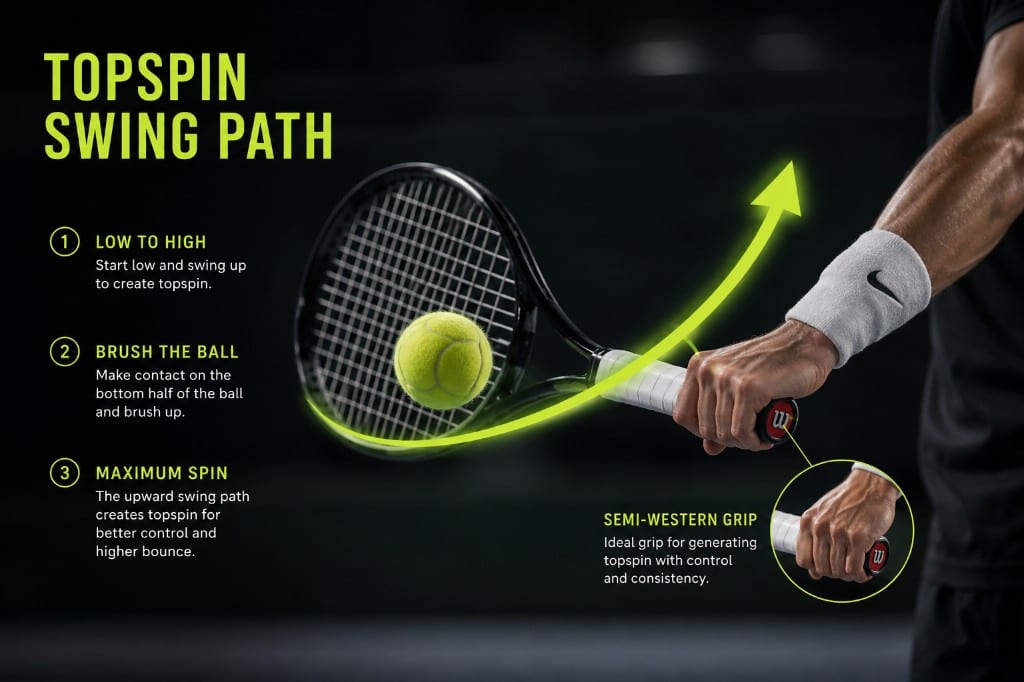
The 3 Core Mechanics of a Perfect Topspin Stroke
To generate consistent topspin, your stroke must incorporate three fundamental components:
- The Semi-Western Grip: Place the index knuckle of your dominant hand on the fourth bevel of your racket handle. This slightly closed racket face naturally encourages topspin on contact.
- The Low-to-High Swing Path: Your racket head must drop below the height of the oncoming ball before moving forward and upward.
- The “Brush” Contact: Instead of striking directly flat through the back of the ball, your strings must slide upward against the felt of the ball.
3 Drills to Practice Tennis Topspin Alone
Drill 1: The Dropped-Ball Self-Feed
How to do it: Stand in an open space like a driveway, a quiet tennis court, or against a wall. Drop a tennis ball slightly out in front of your body. Let it bounce. As the ball begins to drop, drop your racket head, swing from low to high, and gently brush up the back of the ball.
The Goal: Do not swing hard. Focus entirely on the physical sensation of the racket face sliding up the ball, and listen for the distinct “friction” sound of the strings brushing the felt.
Drill 2: The Fence Shadow-Swing
How to do it: Stand roughly 6 to 12 inches away from a chain-link court fence, facing it directly. Practice your shadow swing slow-motion. If your racket frame strikes the fence during your follow-through, your swing path is too flat.
The Goal: The physical boundary of the fence forces your hand to move on a steep, vertical upward path, directly training the low-to-high motion.
Drill 3: The Stationary Spin Repetition Drill
The Challenge: While dropped-ball drills are excellent, they can be highly frustrating for beginners. If your drop is inconsistent, your contact point shifts, which prevents you from building clean muscle memory.
The Solution: To build muscle memory quickly, you need to strip away the moving parts. Practicing your stroke against a stationary, resetting ball allows you to repeat the exact same “brush” motion hundreds of times in a single session.
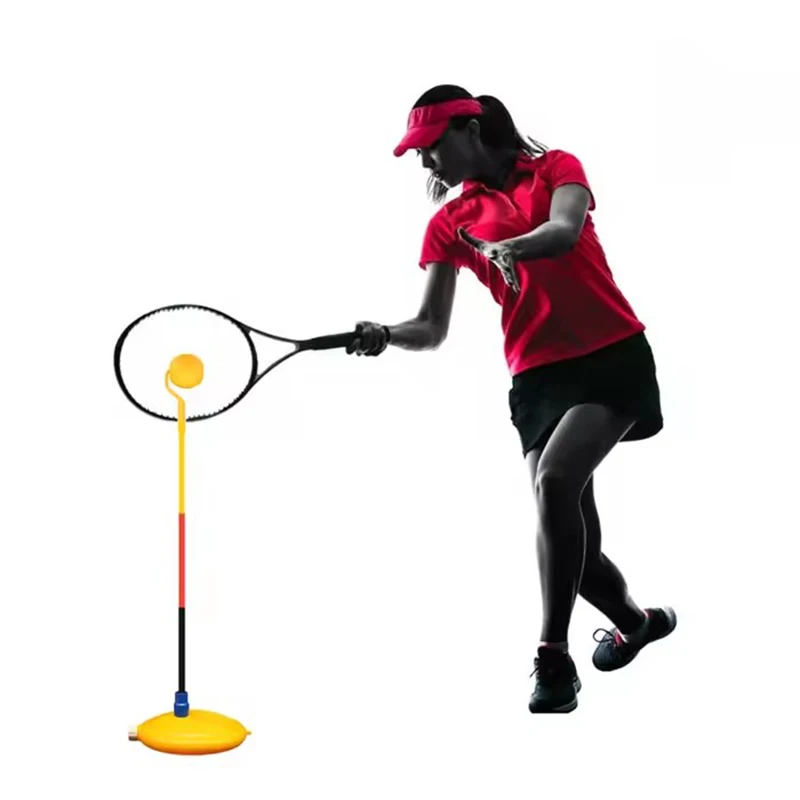
Master Your Topspin At Home
Stop chasing loose balls and start building correct muscle memory. The SoloReps Adjustable Tennis Topspin Trainer features adjustable resistance to help players of all levels master the low-to-high brush technique in their driveway or backyard.
$84.99
Common Mistakes to Avoid When Practicing Solo
When practicing on your own without a coach, it is easy for bad habits to slip in. Watch out for these two common pitfalls:
- Flicking your wrist: True topspin is generated by the upward acceleration of your forearm and shoulder, not by rolling or flicking your wrist at contact. Keep your wrist firm and laid back through the strike.
- Swinging too fast: Speed destroys mechanics when you are learning a new motion. Slow your swing down to 30% of your maximum power until you can consistently hear and see the ball rotating forward.
Wrap Up: Consistency Beats Power
When it comes to tennis, consistency always beats raw power. Spending 15 minutes a day performing deliberate, focused solo drills will do more for your stroke than a 2-hour hitting session with poor form.
Pick one of the drills above, focus entirely on the low-to-high brush path, and start building the muscle memory that wins matches. Browse more tennis training guides or shop the topspin trainer.